Marketing Strategy for Startups: How to Grow on a Limited Budget
A practical marketing strategy for startups with little or no budget. Learn the steps that actually drive early growth without burning cash on ads that do not convert.
Most startups do not fail because the product is bad. They fail because not enough of the right people ever hear about it - or the wrong people do. The good news: you do not need a big budget to market a startup well. You need a clear, focused strategy you can start this week.
Quick definition: A startup marketing strategy answers four questions - who is your best customer, why should they choose you, where will you reach them, and how will you measure it. Everything else is detail.
Why most startup marketing fails
Three mistakes show up again and again:
- Talking to everyone. A message for "all businesses" feels like it is for no one.
- Copying big brands. Zomato and Zerodha can spend on brand campaigns. You cannot, and you should not try.
- Doing random activities. One reel here, one cold email there, with no plan tying it together. Activity is not strategy.
Here is how startup marketing should differ from big-company marketing:
| Big company | Your startup | |
|---|---|---|
| Goal | Brand awareness | The next 10 customers |
| Budget | Large, can wait | Small, needs results fast |
| Audience | Broad | One narrow group |
| Channels | Many at once | 1-2 done well |
| Message | Emotional / brand | Clear problem + clear fix |
If you remember one thing: do less, but do it for a sharper audience.
Step 1: Get clear on your ICP
Your ideal customer profile is the customer who gets the most value from you, pays without fuss, and stays. A weak ICP: "small businesses in India." A strong ICP: "early-stage D2C skincare brands doing 5-20L per month who run their own ads but cannot figure out why sales are flat." The second one tells you exactly what to say and where to find them.
Step 2: Nail your positioning
Positioning is why someone should choose you over the alternatives, including doing nothing. Fill in this line:
For [your ICP] who [have this problem], I help them [get this outcome] - unlike [the usual option].
That one sentence becomes the backbone of your site, bio, and pitch. Learn more in what is product positioning.
Step 3: Pick one or two channels
Do not try Instagram, LinkedIn, SEO, ads, and email at once. Pick based on where your ICP already is and how fast you need results.
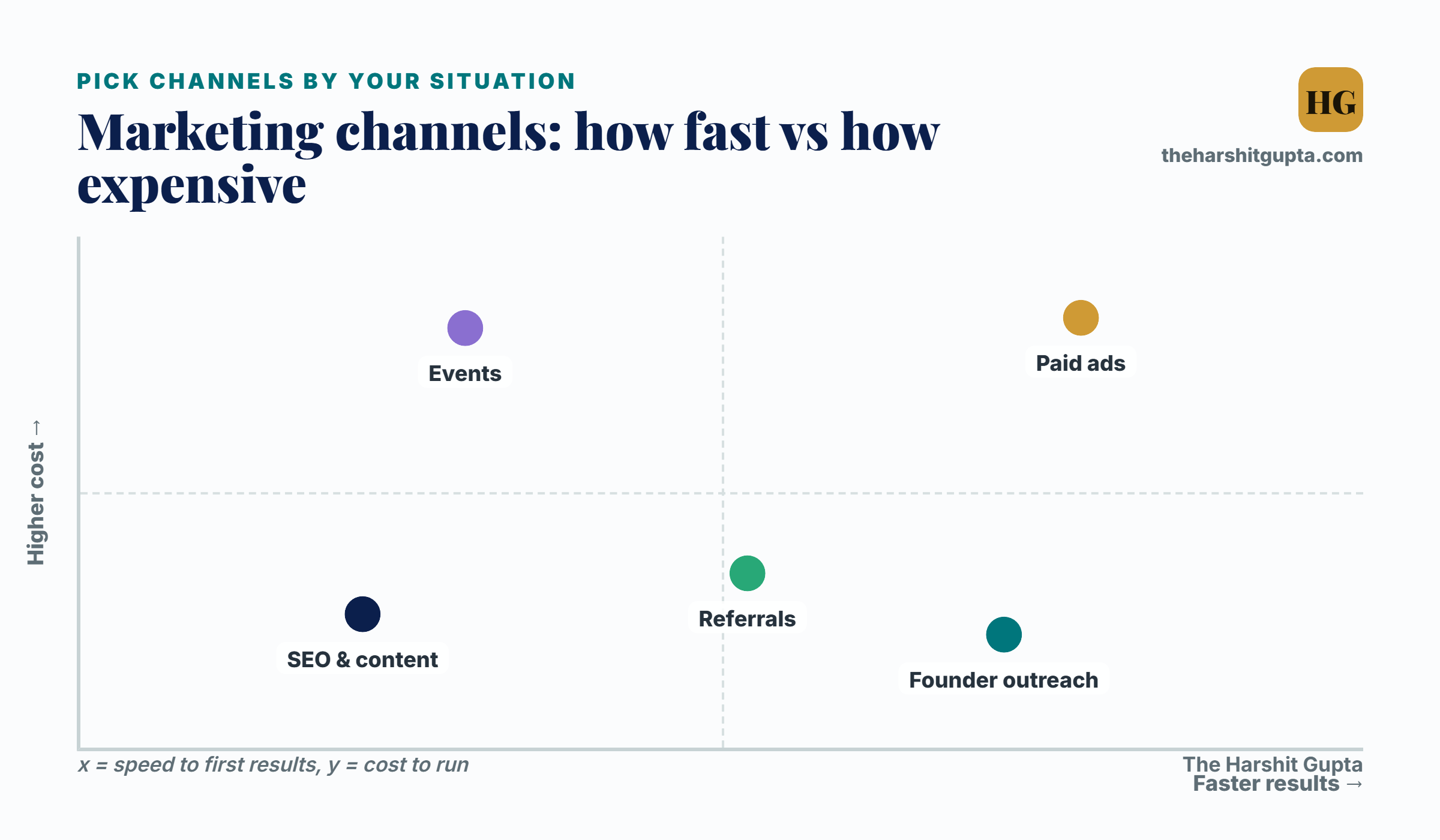
Founder-led outreach is fast and cheap - the best first channel for most startups. SEO is cheap but slow, so start it now and let it compound.
- Need customers this month? Founder-led outreach plus referrals.
- Building for 6-12 months? SEO and content.
- Have a little cash? Small paid tests, only after your message is proven.
Step 4: Set a focused budget
You do not need a big budget, you need a focused one. A sensible early split:
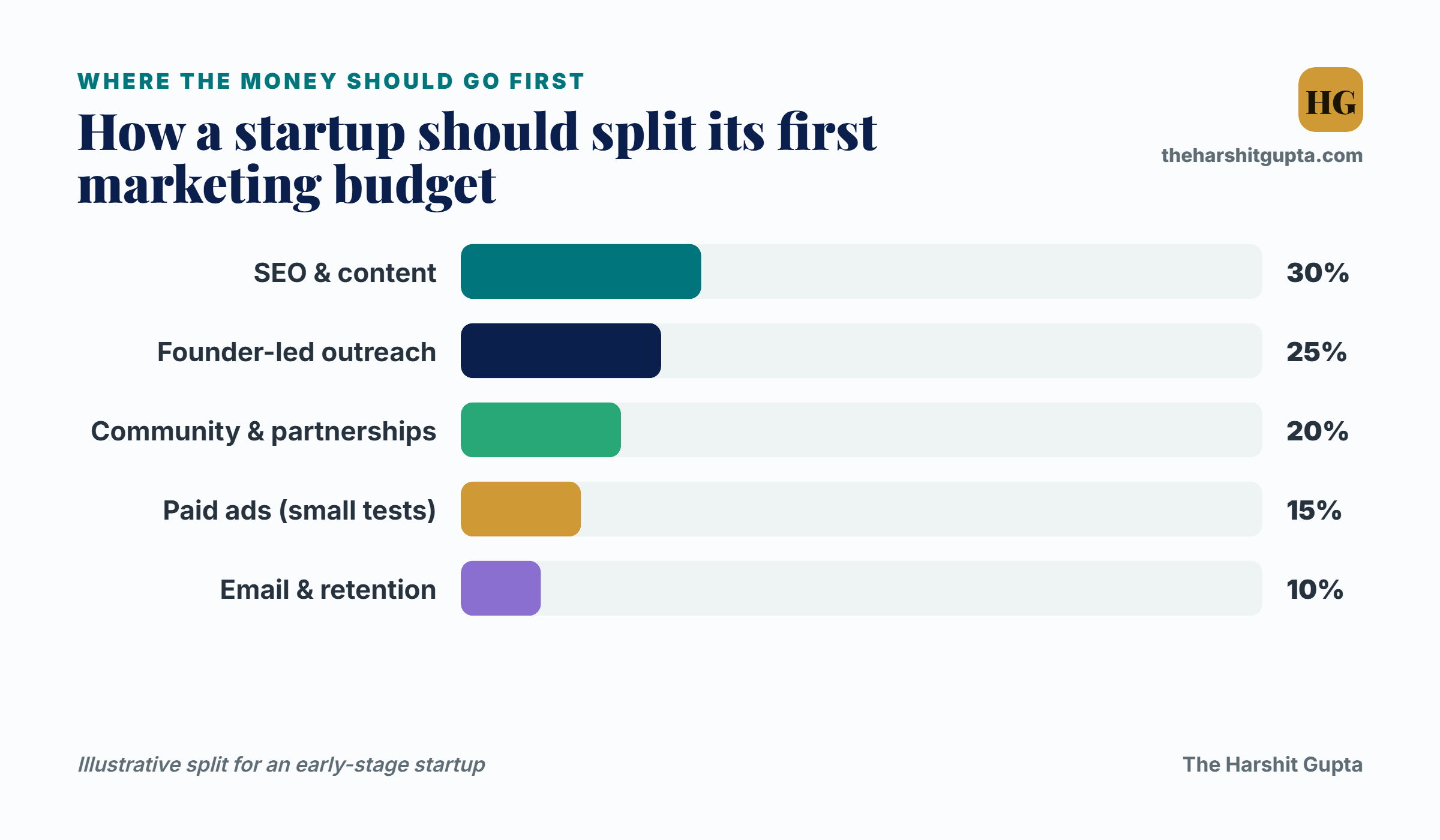
Paid ads are only 15%. Early on, your time and your message matter more than ad spend.
Step 5: Build a simple funnel and measure it
A funnel is just the path from stranger to customer. Know your numbers at each stage so you know what to fix.
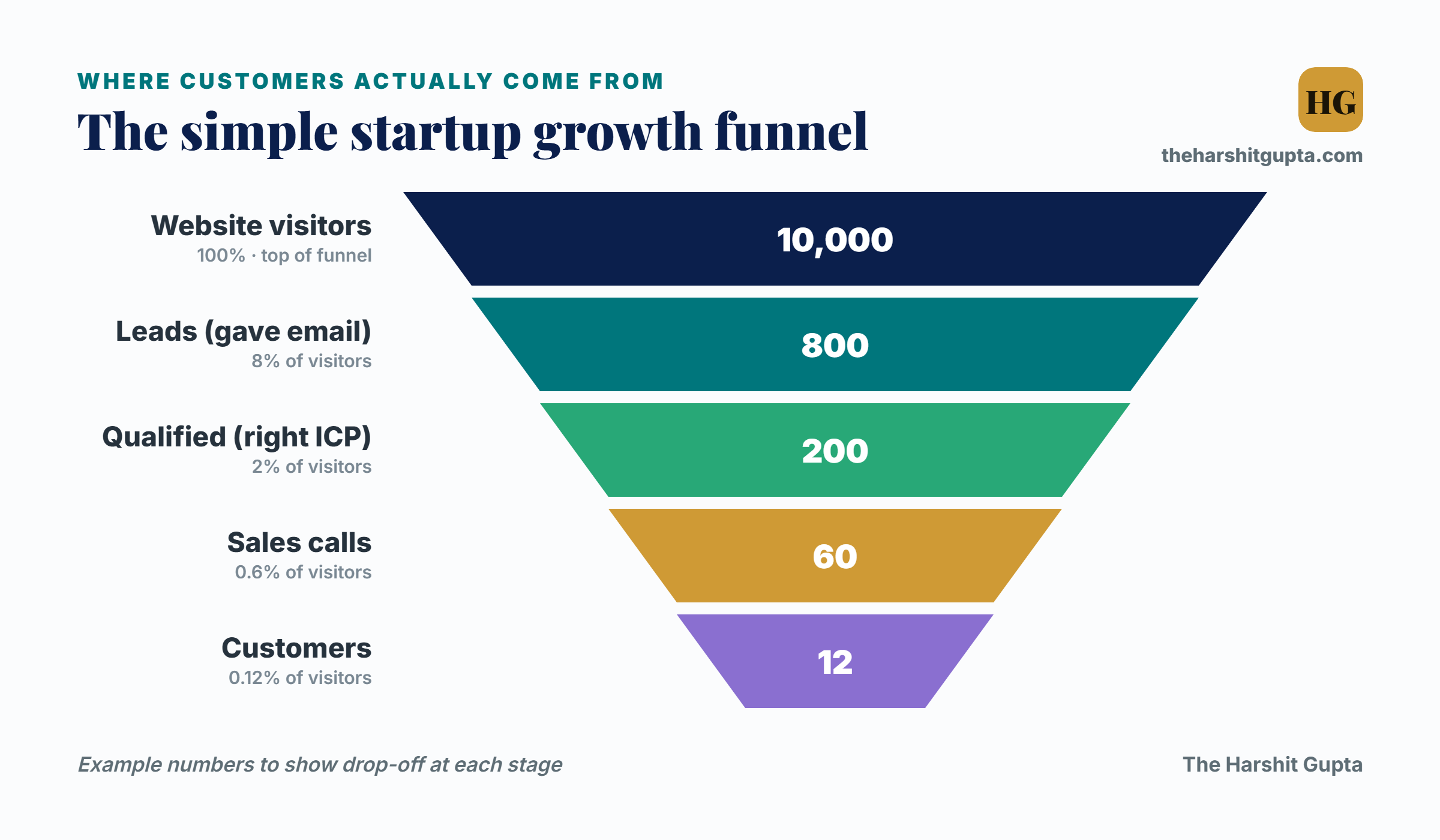
If 10,000 visitors become only 12 customers, the leak is often the message or offer in the middle, not the traffic.
Track three things first: leads, conversations, and customers. If leads are high but customers are low, your offer or positioning is the problem - not your traffic. See marketing KPIs to track.
A quick example
Illustrative example, not a named client: a founder selling salon scheduling software ran Instagram ads to "small businesses" and got nothing. Three changes fixed it - a sharper ICP ("single-location salons with 3-8 staff"), a sharper message ("stop losing 15,000 per month to no-shows"), and a switch from ads to direct DMs plus a free no-show calculator. Six weeks later: 9 paying salons, with less spend. The product did not change; the strategy did.
Key takeaways
- A strategy is just who, why, where, and how to measure.
- Target one narrow ICP, not everyone.
- Outreach for speed, SEO for the long game.
- Keep paid ads small until your message converts.
Frequently asked questions
How much should a startup spend on marketing? Early on, very little cash - most of your budget is your time on outreach and content. Keep paid ads to roughly 10-15% until your message converts. See how much should a startup spend on marketing.
What is the best first channel? For most startups, founder-led outreach plus referrals, because it is fast and nearly free. Start SEO at the same time for later.
How long until marketing works? Outreach can create conversations in days; SEO usually takes 3-6 months. Start early and stay consistent.
Want a plan tailored to your startup? See my GTM Clarity Sprint and grab the free ICP Clarity Checklist.
Want clearer customers before your next campaign?
Download the free ICP Clarity Checklist and turn broad audience guesses into sharper messaging, content, and targeting.
Download the Free ICP ChecklistWant this applied to your business?
Get a free 3-point audit and a clear next step for your marketing.
Get My Free 3-Point Audit