How to Find Your Target Audience for a New Product
No audience means no sales. Learn how to find and validate the right target audience for a new product before you spend money on ads or content.
When you launch something new, the scariest question is "who is this actually for?" Guess wrong and you waste months talking to the wrong people. Here is how to find and validate your target audience the practical way.
Quick rule: Start from the problem, not the product. The people with the most painful version of the problem are your first audience.
Why most founders guess (and pay for it)
Founders fall in love with the product and assume "everyone" needs it. But a message for everyone speaks to no one. A specific audience is what makes marketing affordable and effective.
Start from the problem, not the product
Ask: what painful, urgent problem does my product solve, and who has it most badly? Those people pay sooner and forgive more.
5 places to find your audience
| Where | What to look for |
|---|---|
| Your network and early users | People who already relate to the problem |
| Competitor reviews | Who complains, and about what |
| Communities (Reddit, Slack, Discord) | Active discussion of your topic |
| LinkedIn / X search | Job titles and keywords that fit |
| Marketplaces and forums | Where buyers gather and ask |
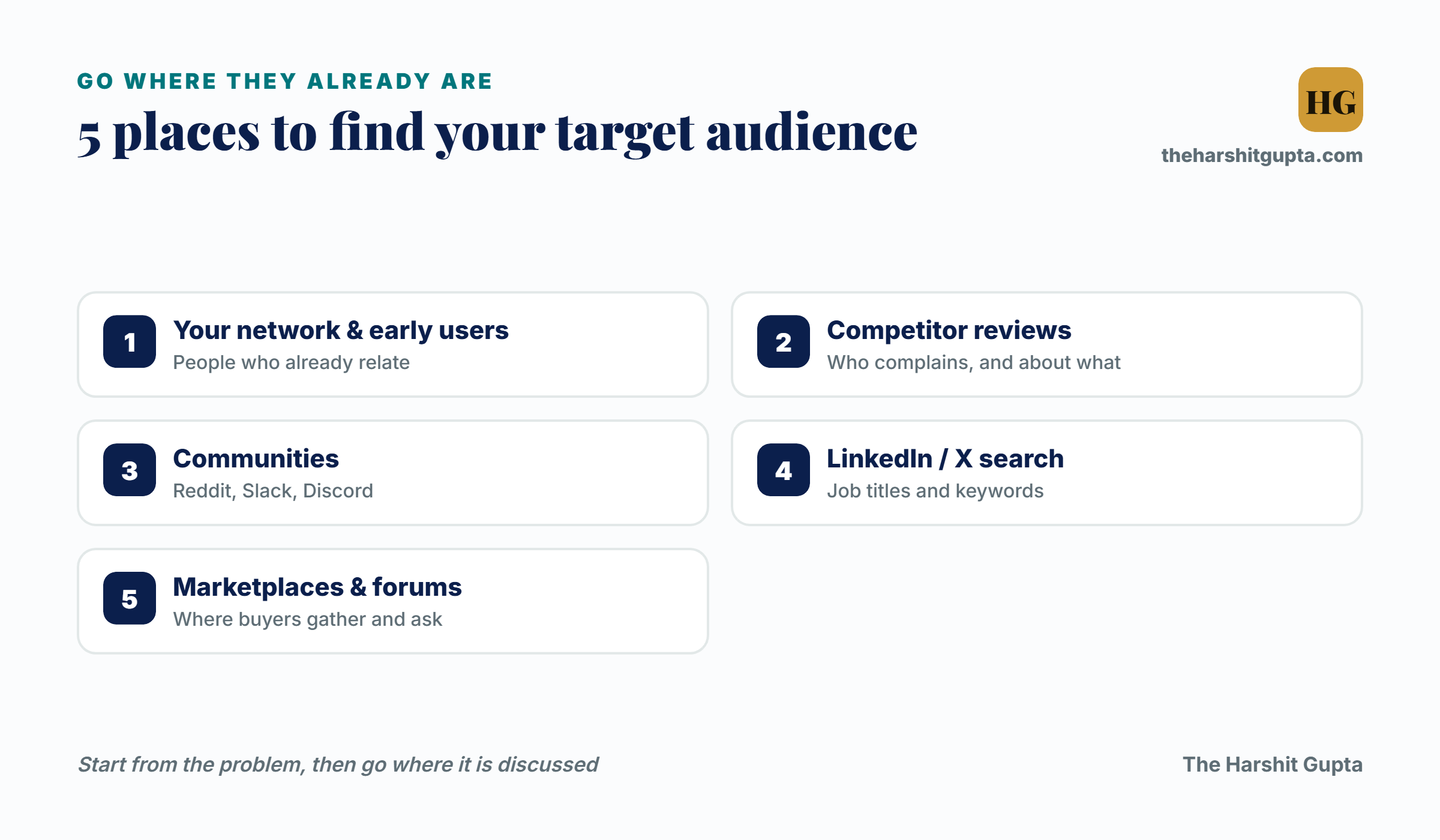
Find your audience where they already gather.
How to validate (cheaply)
- Talk to 10 people who fit your guess. Do they actually have the problem?
- Run a tiny test: a landing page, a poll, or a small ad set, and measure interest.
- Watch language: if people ask "when can I get this?", you are close.
Red flags you picked the wrong audience
- Lots of polite interest but nobody will pay.
- You constantly explain why the problem matters.
- The people you reach cannot make a buying decision.
A quick example
Illustrative example, not a named client: a founder built a tool "for all freelancers." Sales were flat. After interviews, they narrowed to "freelance video editors juggling 5+ clients," rewrote everything for that niche, and finally got traction - then expanded outward later.
Turn the audience into a profile
Once you find them, write it down as an ideal customer profile so the whole business points at the same person. For deeper methods, see customer research methods.
Key takeaways
- Begin with the problem and who feels it most.
- Find your audience where they already gather.
- Validate with real conversations and tiny tests before spending big.
- Narrow first; expand later.
Frequently asked questions
How do I find a target audience with no customers yet? Start with the problem, list who suffers it most, then interview 10 of them and test interest cheaply.
How narrow should my audience be? Narrow enough that your message feels written for them. You can widen later once you have traction.
What if nobody will pay? That is a signal the problem is not urgent enough for that group - try a segment with a more painful version of the problem.
Need help pinpointing and validating your audience? See my ICP and Buyer Persona Research service and grab the free ICP Clarity Checklist.
Want clearer customers before your next campaign?
Download the free ICP Clarity Checklist and turn broad audience guesses into sharper messaging, content, and targeting.
Download the Free ICP ChecklistWant this applied to your business?
Get a free 3-point audit and a clear next step for your marketing.
Get My Free 3-Point Audit